
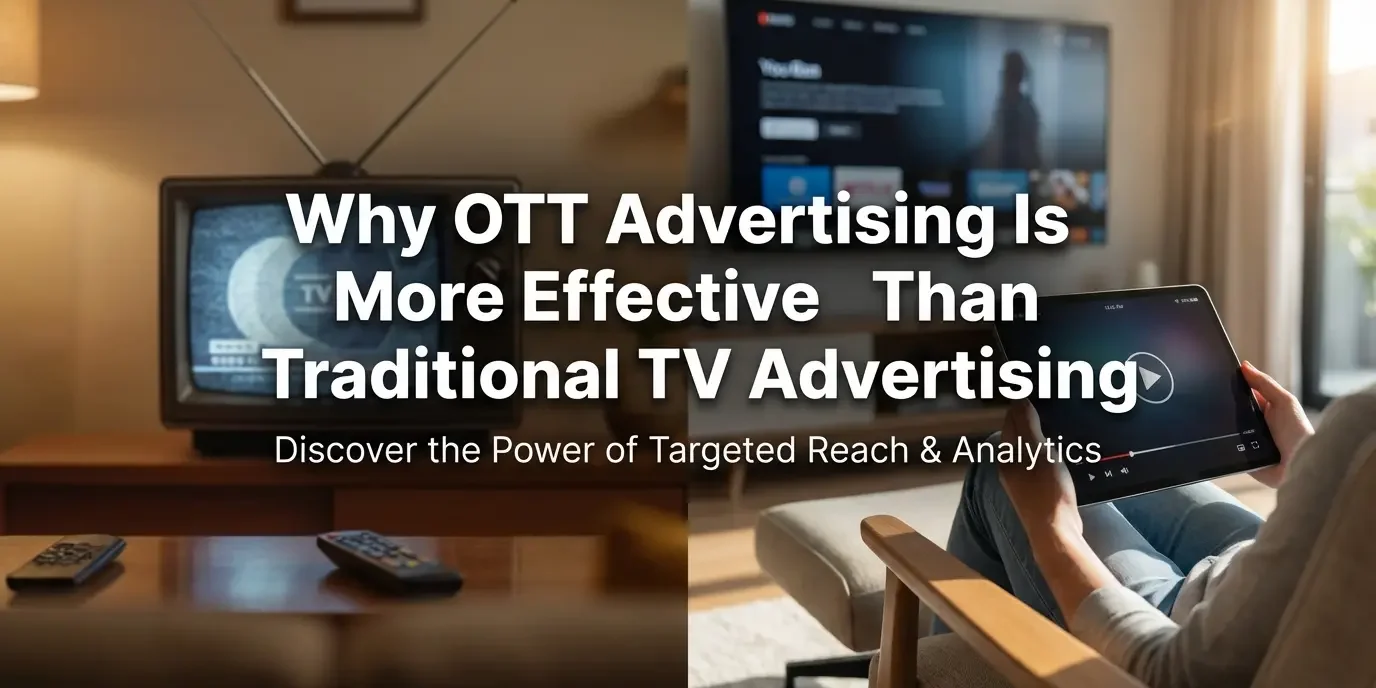
Introduction: The Streaming-First Advertising Era
The way Americans consume television has fundamentally changed — and advertising must change with it. In July 2022, U.S. streaming usage surpassed traditional cable TV for the first time, and there has been no reversal. As of 2025, streaming accounts for 43.8% of all U.S. TV viewing time, and 96% of U.S. households — roughly 125 million homes — now stream video content through Over-the-Top (OTT) platforms.
Global OTT ad spending is projected to reach $207.52 billion in 2025, with U.S. OTT revenue alone forecasted at $146.30 billion — 64% of which is driven by advertising. Meanwhile, 56% of global marketers plan to increase their OTT and CTV spend this year, led by sectors like automotive, healthcare, and entertainment.
The shift is clear: audiences have moved to streaming, and advertisers who fail to follow are leaving money — and customers — on the table. But what exactly makes OTT advertising more effective than traditional TV? Let’s break it down with the latest data.
96% of U.S. households now stream video content — Up from just 52% in 2015. OTT is no longer emerging technology; it’s the dominant way Americans watch TV.
1. What Is OTT Advertising?
Before diving into the advantages, it’s important to understand what OTT advertising actually is. OTT (Over-the-Top) refers to video content delivered directly over the internet, bypassing traditional cable or satellite TV services. Popular OTT platforms include Netflix, Hulu, Disney+, Amazon Prime Video, Peacock, Tubi, Roku, and Paramount+.
OTT advertising involves placing video ads within this streaming content — either through ad-supported subscription tiers (like Netflix’s ad-supported plan or Disney+ with ads) or through free ad-supported streaming TV (FAST) channels like Tubi and Pluto TV.
A closely related term is CTV (Connected TV), which refers specifically to the devices used to stream OTT content on a television screen — smart TVs, Roku, Amazon Fire TV, Apple TV, and gaming consoles. In practice, CTV is the device, and OTT is the content delivery method. Together, they represent the future of television advertising.
Unlike traditional TV, which relies on a broad, one-size-fits-all approach, OTT platforms provide a dynamic, data-driven environment for brands to target specific audiences with personalized, measurable messages.
2. Precision Audience Targeting
The most transformative advantage of OTT advertising is its ability to target specific audiences with digital precision. Traditional TV advertising relies on broad demographic estimates tied to programming and time slots. If you buy a 30-second spot during the evening news, you’re paying to reach everyone watching — regardless of whether they’re your ideal customer.
OTT platforms flip this model entirely, offering advanced targeting methods that include:
Demographic Targeting: Reach viewers based on age, gender, income level, household composition, and more. Whether your ideal customer is a young parent, a high-income professional, or a Gen Z consumer, you can narrow your audience accordingly.
Behavioral Targeting: Target consumers based on their actual viewing habits and interests. If someone frequently watches cooking content, fitness programming, or automotive shows, you can serve ads for related products and services — reaching people based on demonstrated interest, not assumed interest.
Geo-Targeting: Serve ads based on the viewer’s specific location. This is critical for local businesses — a restaurant, dealership, or entertainment venue can target only viewers within their service area, eliminating wasted spend on audiences too far away to convert.
Device Targeting: OTT ads can be tailored to specific devices — smart TVs, smartphones, tablets, or desktops — ensuring your creative is optimized for the screen the viewer is using.
Retargeting: Unlike traditional TV, OTT allows you to retarget viewers who have previously interacted with your brand online, creating a connected customer journey from ad impression to website visit to conversion.
This level of precision dramatically reduces wasted ad spend. Every dollar goes toward reaching people who are more likely to engage, click, and buy — rather than broadcasting to millions of unqualified viewers.
3. Superior Cost-Effectiveness
Traditional TV advertising is expensive — and the cost structure is rigid. A 30-second national prime-time spot can cost hundreds of thousands of dollars. Even local cable TV buys require significant minimums, long-term commitments, and upfront budget allocation with little flexibility to adjust once the buy is made.
OTT advertising operates on a fundamentally different economic model. Ads are typically sold on a cost-per-thousand-impressions (CPM) basis, with programmatic buying enabling real-time bidding and budget optimization. Current CTV benchmark CPMs range from approximately $20 to $40 for premium inventory, though self-serve platforms offer entry points as low as $6 to $10 CPM for small and mid-sized businesses.
What This Means for Your Budget
With OTT, you can launch a campaign with a modest budget, test creative and targeting, and scale up only what’s performing. There are no long-term contracts or massive upfront commitments required. You can run hyper-local campaigns targeting a single metro area or zip code without paying for national reach you don’t need.
For context, the average U.S. household now pays for 4.1 streaming subscriptions (up from 2.9 in 2019), and 61% of Millennials and 58% of Gen Z actively prefer ad-supported plans to save money. This means ad-supported OTT audiences are large, growing, and receptive — giving advertisers access to engaged viewers at a fraction of traditional TV costs.
88% of cord-cutters’ viewing time is spent on free ad-supported content — These viewers have actively chosen ad-supported streaming, making them more receptive to advertising than traditional TV audiences.
4. Unmatched Engagement and Completion Rates
This is where OTT advertising truly separates itself from traditional TV. On traditional television, viewers routinely change channels during commercial breaks, leave the room, or fast-forward through ads on DVR recordings. There is no reliable way to confirm whether a viewer actually watched your ad.
OTT and CTV advertising delivers dramatically higher engagement. Industry data shows that ad completion rates on Connected TV devices reach up to 98% on average — far surpassing desktop (84%) and mobile (86%) completion rates. Because most CTV ads are non-skippable and served within premium, long-form content that viewers actively chose to watch, attention levels are significantly higher than traditional TV.
Interactive Capabilities
Beyond passive viewing, OTT platforms increasingly support interactive ad formats that traditional TV simply cannot offer. These include clickable ads that drive viewers directly to a website or landing page, QR codes that viewers can scan with their phones for immediate engagement, shoppable content that lets viewers purchase products in real time, and interactive overlays like surveys or product selectors.
Research shows that 64% of consumers respond to interactive ad formats, making them a powerful conversion tool. This two-way engagement transforms advertising from a broadcast monologue into a measurable conversation — something traditional TV has never been able to achieve.
5. Real-Time Measurement and Analytics
One of traditional TV advertising’s greatest weaknesses has always been measurement. For decades, advertisers relied on Nielsen ratings — sample-based estimates that provide a rough picture of viewership but cannot tell you exactly who watched your ad, whether they watched it to completion, or what action they took afterward.
OTT advertising provides comprehensive, real-time analytics that make every dollar accountable. Key metrics available to OTT advertisers include:
Impressions: Exactly how many times your ad was served to viewers.
Video Completion Rate (VCR): The percentage of viewers who watched your ad in its entirety. Healthy CTV benchmarks sit at 90% or higher.
Engagement Metrics: How viewers interacted with your ad — QR code scans, remote clicks, interactive overlay actions, and more.
Conversion Tracking: How many viewers took a desired action after seeing your ad, such as visiting your website, filling out a form, or making a purchase.
Cross-Device Attribution: The ability to track a viewer’s journey across multiple devices — seeing your ad on a smart TV, researching on a tablet, and converting on a phone.
Incremental Lift Studies: Advanced measurement using clean rooms and geo-matched testing to determine the actual business impact of your OTT campaigns beyond what would have happened organically.
This data allows you to optimize campaigns in real time, shifting budget toward what’s working and pausing what isn’t. Traditional TV offers no comparable level of accountability or agility.
6. The Audience Has Already Moved to Streaming
The shift from traditional TV to streaming isn’t a trend — it’s a completed migration for most American households. The numbers are decisive:
89% of U.S. households have at least one video streaming subscription. The average household subscribes to 4.1 streaming services and spends approximately $61 per month on streaming platforms. Millennials and Gen Z account for 65% of overall OTT viewership, with Gen Z watching an average of 6.5 hours of streaming video per day and Millennials watching 5.7 hours. But older demographics are streaming too — 79% of adults aged 50+ now use streaming services (up from 62% in 2020), and streaming usage among Baby Boomers increased 30% between 2021 and 2024. Even more telling, 21% of adults 50+ have completely abandoned traditional cable and rely solely on streaming.
96% of cord-cutters aged 50+ report being satisfied with their decision to cancel cable or satellite. This is not a generation gap anymore — streaming is a cross-generational habit, and OTT advertising is the only way to reach the growing segment of Americans who have left traditional TV entirely.
Millennials and Gen Z = 65% of OTT viewership. But 79% of adults 50+ also stream regularly. OTT reaches every generation — traditional TV increasingly does not.
7. Flexibility and Real-Time Optimization
Traditional TV advertising is rigid by nature. Once a commercial is produced and a media buy is placed, you’re locked in. If the ad isn’t resonating, if market conditions change, or if a competitor launches a competing campaign, you have little ability to adapt.
OTT advertising is built for agility. Campaigns can be launched, paused, edited, and optimized in real time based on performance data. Specific advantages include:
A/B Testing: Run multiple versions of your creative simultaneously to determine which messaging, visuals, or calls to action perform best — then automatically allocate budget to the winner.
Dynamic Creative Optimization: AI-powered tools can automatically adjust ad creative based on viewer data, time of day, device type, or content context, delivering personalized variations without manual intervention.
Real-Time Budget Shifts: Move spend between platforms, audience segments, or geographic targets instantly based on what the data shows. No waiting for the next upfront negotiation or media buy cycle.
Sequential Messaging: Serve a series of ads to the same viewer over time, telling a brand story across multiple touchpoints — something traditional TV’s random rotation simply cannot achieve.
As programmatic buying continues to grow — projected to reach 75% of OTT inventory by 2027, up from 50% in 2024 — the efficiency and automation advantages of OTT advertising will only accelerate.
8. AI-Powered Advertising: The 2025 Advantage
Artificial intelligence is rapidly transforming OTT advertising in ways that further widen the gap with traditional TV. AI enables hyper-personalized ad delivery by analyzing viewer data to predict preferences and optimize placements in real time — at a scale no human media buying team could replicate.
The Interactive Advertising Bureau (IAB) reports that 86% of advertisers already use or plan to use generative AI in video ad creation, primarily to increase creative volume and testing speed. The IAB further projects that nearly 40% of all video ads will involve generative AI by 2026.
For businesses, this means faster creative production and testing cycles, more personalized ad experiences tailored to individual viewer preferences, automated campaign optimization that continuously improves performance, and predictive analytics that identify high-value audience segments before you spend a dollar.
Traditional TV advertising has no equivalent infrastructure for this level of intelligent, automated optimization. The gap between OTT’s data-driven precision and traditional TV’s broad-brush approach grows wider every quarter.
OTT Advertising vs. Traditional TV: Side-by-Side Comparison
| Factor | OTT Advertising | Traditional TV Advertising |
|---|---|---|
| Targeting | Granular: demographics, behavior, geo, retargeting, device | Broad: programming-based, time slot estimates |
| Cost Structure | CPM-based; scalable budgets; no minimums on many platforms | Fixed upfront media buys; high minimums; rigid commitments |
| Ad Completion | 90–98% on CTV (non-skippable) | Unverifiable; DVR skip rates 60–80% |
| Measurability | Real-time: impressions, VCR, conversions, cross-device attribution | Estimated: Nielsen sample ratings, delayed reporting |
| Engagement | Interactive: clickable, shoppable, QR codes, overlays | Passive: one-way broadcast only |
| Flexibility | Real-time optimization, A/B testing, dynamic creative | Locked once produced and placed |
| Audience Reach | 96% of U.S. households; cross-generational; growing | Declining viewership; cord-cutting accelerating |
| AI Integration | Predictive targeting, automated optimization, generative creative | Minimal technology integration |
| Interactivity | Direct response pathways: click, scan, shop | No direct response mechanism |
| Budget Accessibility | Self-serve platforms available at $6–10 CPM for SMBs | Significant minimums; local cable still $5K–$25K+ |
Where Traditional TV Still Has a Role
It’s worth noting that traditional TV advertising is not entirely obsolete. For certain use cases — major cultural events like the Super Bowl, broad brand-awareness campaigns, and reaching older demographics who haven’t adopted streaming — traditional TV can still play a supporting role.
However, the data increasingly shows that even these advantages are narrowing. Streaming platforms now carry live sports (ESPN+, Amazon Thursday Night Football, Apple TV MLS), and older audiences are adopting streaming at accelerating rates. The most effective advertising strategies in 2025 combine OTT’s precision and measurability with traditional TV’s remaining broad-reach advantages in an integrated, omnichannel approach.
Conclusion: OTT Is No Longer Optional — It’s Essential
The data is clear. With 96% of U.S. households streaming content, global OTT ad spend surpassing $207 billion, and ad completion rates reaching 98% on connected TV devices, OTT advertising delivers superior targeting, engagement, measurement, and ROI compared to traditional TV.
For businesses of all sizes — whether you’re a local entertainment venue, an automotive dealership, or a national brand — OTT provides the tools to reach the right audience, at the right time, on the screen they’re actually watching, with full accountability for every dollar spent.
The audience has moved to streaming. Your advertising needs to follow.
Ready to Launch an OTT Advertising Strategy That Drives Results?
Contact us today to learn how OTT and Connected TV advertising can put your brand in front of the audiences that matter most — with precision targeting, real-time analytics, and measurable ROI.
Sources and References
- Statista Market Insights – Global OTT Video Advertising Projections (2025)
- CMG Local Solutions – Video Advertising Trends: The Future of OTT in 2025
- New Road Advertising – Streaming Data-Backed Insights (2025)
- Parks Associates / Leichtman Research Group – U.S. Streaming Household Data
- Interactive Advertising Bureau (IAB) – Generative AI in Advertising Report
- PwC – Global Entertainment & Media Outlook 2025–2029
- eMarketer – U.S. CTV Ad Spending Projections
- Kepler Group – CTV and OTT Advertising Trends (2025)
- Strategus – OTT Performance Marketing Metrics Guide