
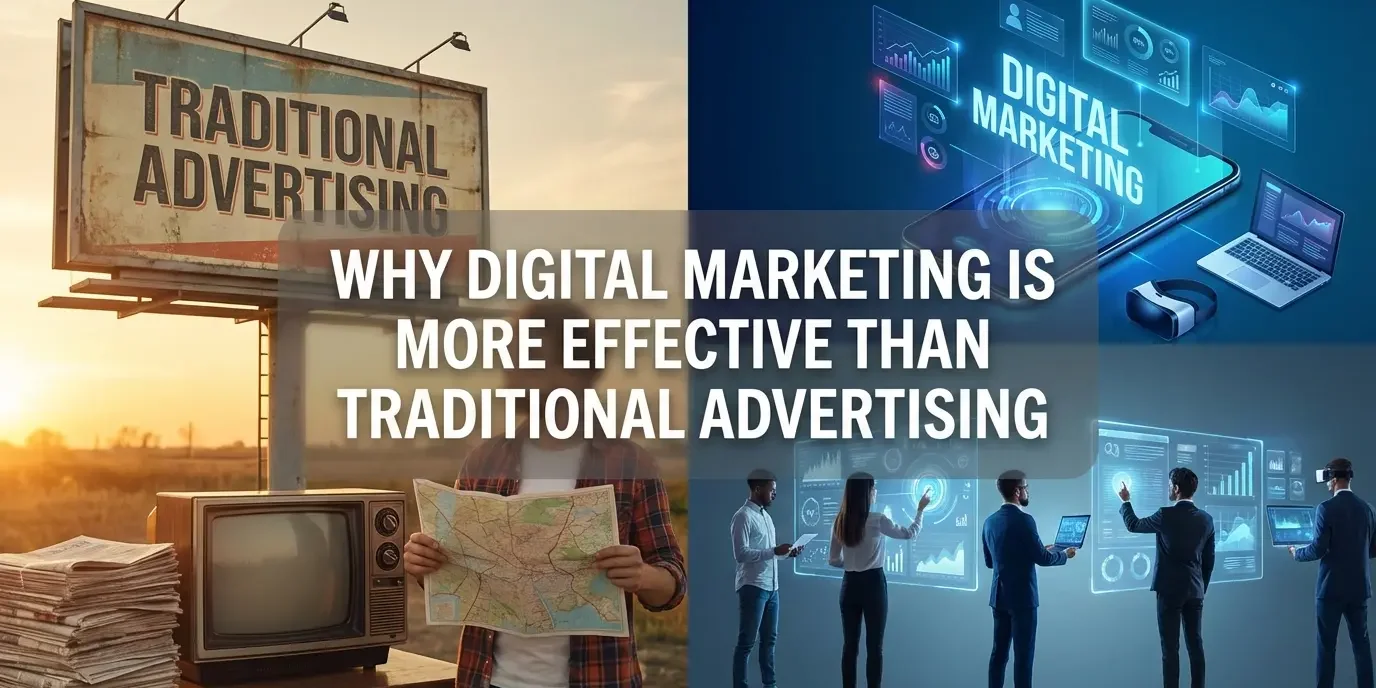
Introduction: The Digital-First Marketing Era
The advertising landscape has undergone a seismic transformation. What was once dominated by television, radio, and print is now a digital-first ecosystem where data, precision, and real-time optimization drive results. In 2026, more than 6 billion people use the internet globally, and digital channels account for 74.4% of total advertising spend worldwide — up from 72.7% just one year prior.
Global marketers are on track to spend $1.16 trillion on advertising in 2025, with digital ad spend alone projected to surpass $740 billion by 2026 according to Statista. The message is clear: businesses that fail to prioritize digital marketing risk falling behind competitors who are leveraging its unmatched targeting, measurement, and cost efficiency.
But why exactly is digital marketing outperforming traditional advertising? This article breaks down the key advantages using the latest industry data and statistics, so you can make informed decisions about where to invest your marketing budget.
$740B+ in global digital ad spend projected for 2026 — Digital channels now command nearly three-quarters of all advertising investment worldwide.
1. Precision Audience Targeting
One of digital marketing’s most transformative advantages is the ability to reach highly specific audiences based on demographics, interests, behaviors, purchase history, and location. Traditional advertising broadcasts a message to a general audience — a TV spot during prime time, a billboard on a highway, or a full-page newspaper ad — with limited ability to control who actually sees it.
Digital platforms like Meta (Facebook and Instagram), Google Ads, TikTok, and LinkedIn provide granular targeting controls that let you narrow your audience to the exact customer profile most likely to convert. You can target by age, location, income level, job title, recent search behavior, website visit history, and even life events.
What the Data Shows
According to industry research, 58% of marketers still struggle with targeting and segmenting their audience effectively — which means the brands that master digital targeting gain a substantial competitive advantage. Meanwhile, Facebook advertising alone can reach 76% of American adults, and Instagram ads generate engagement rates roughly 6x higher than Facebook’s.
The practical impact is significant: rather than paying to reach millions of people who have no interest in your product, you invest your budget in reaching only those prospects most likely to engage, click, and buy. For businesses in specialized industries like VR entertainment, automotive, or medical spas, this targeting precision is the difference between wasted spend and profitable campaigns.
2. Superior Cost-Effectiveness
Traditional advertising is notoriously expensive. A 30-second national TV commercial during prime time can cost hundreds of thousands of dollars, a full-page print ad in a major publication can run $50,000 or more, and radio spots in top markets carry significant premiums — all with no guarantee of engagement or conversion.
Digital marketing operates on a fundamentally different economic model. With pay-per-click (PPC) advertising, you only pay when someone actively engages with your ad. The average cost-per-click on Google Ads across all industries is approximately $2.96, and social media ad costs can be even lower depending on the platform and audience.
Key Cost Comparisons
Content marketing costs approximately 62% less than traditional methods while generating roughly 3 times as many leads. Email marketing delivers an extraordinary return of $36 to $42 for every $1 invested, making it one of the highest-ROI channels available to any business. The global email marketing industry alone is valued at over $8.49 billion.
For small and mid-sized businesses, digital marketing’s cost flexibility is critical. You can start a Facebook or Google Ads campaign with as little as $5 per day, test performance, and scale up only what works. Traditional media offers no such flexibility — you commit budget upfront with minimal ability to adjust.
Email marketing delivers $36–$42 ROI for every $1 spent — That’s an ROI of 3,600% to 4,200%, vastly outperforming most traditional channels.
3. Measurable, Real-Time Analytics
One of digital marketing’s most decisive advantages is comprehensive measurement. Traditional advertising has always struggled with attribution — as the famous saying goes, “Half the money I spend on advertising is wasted; the trouble is, I don’t know which half.”
Digital marketing eliminates that guesswork. Platforms like Google Analytics 4, Meta Ads Manager, and marketing automation tools provide real-time data on impressions, clicks, conversions, cost per acquisition, customer lifetime value, and revenue attribution.
Critical Metrics That Matter in 2026
According to HubSpot’s 2026 State of Marketing Report, the top metrics marketers are tracking include lead quality and MQLs (39%), lead-to-customer conversion rate (34%), ROI (31%), customer acquisition cost (30%), and lead generation volume (29%). Additionally, 56% of marketers report it is significantly easier to improve conversion rates now than it was a decade ago, thanks to AI-powered optimization and advanced testing tools.
This data-driven approach means you can identify underperforming campaigns within hours — not weeks — and reallocate budget to what’s working. Traditional advertising simply cannot provide this level of granularity or speed. By the time you learn a TV ad isn’t resonating, you’ve already spent the entire production and media buy budget.
4. Real-Time Interaction and Customer Engagement
Traditional advertising is a one-way channel. A TV commercial, a magazine ad, or a radio spot delivers a message — and that’s it. There is no built-in mechanism for the audience to respond, ask questions, or provide feedback in the moment.
Digital marketing transforms advertising into a two-way conversation. Social media platforms, email campaigns, live chat, chatbots, and community forums allow brands to engage directly with customers in real time. This interaction builds trust, fosters loyalty, and creates brand advocates.
Engagement by the Numbers
Research shows that YouTube mobile ads are 84% more likely to hold attention compared to TV ads, and 75% of Instagram users take a measurable action (visiting a website, making a purchase) after seeing an ad. Meanwhile, 77% of consumers discover new products through social media ads, and businesses that regularly respond to online reviews see customers spend up to 50% more.
Video content in particular has become a dominant engagement driver. According to 2026 industry data, 92% of businesses now consider video one of the most important components of their digital marketing strategy, and video ads improve brand recall by approximately 80% compared to static creative.
5. Flexibility, Agility, and Rapid Optimization
If a TV commercial isn’t performing well, you can’t pull it back and revise it on the spot. You’re locked into a media buy, a creative asset, and a schedule. Digital marketing operates on the opposite principle — everything is fluid, testable, and optimizable.
A/B testing is standard practice in digital campaigns. You can test multiple headlines, images, calls to action, landing pages, and audience segments simultaneously, then let the data determine the winner. Research shows that structured A/B testing alone lifts conversions by an average of 18% over six months, and brands running dedicated conversion rate optimization (CRO) programs see an average ROI of 223%.
This agility extends to budget allocation as well. In 2026, AI-powered campaign management tools can automatically shift spend between channels and creatives in real time based on performance signals — something no traditional media buy can replicate. In fact, 64% of advertisers plan to increase AI-driven ad investments in the coming year.
6. Scalable Global and Local Reach
Traditional advertising reach is typically constrained by geography. A radio ad serves one metro market. A newspaper ad is limited to that publication’s circulation. A billboard reaches only the traffic passing a specific location.
Digital marketing transcends these boundaries. A well-targeted social media campaign can reach audiences across cities, states, or countries with equal precision. At the same time, local digital strategies like Google Business Profile optimization, local SEO, and geo-targeted ads allow small businesses to dominate their immediate service area.
The Scale of Digital Reach
Combined spending on online search and social media now represents approximately 54% of all global advertising spend across both digital and traditional channels. Social media advertising alone is growing at 13.6% annually, reaching $277 billion in 2025, while online retail advertising is surging at 22% year-over-year growth. Whether your business needs to reach customers within a 10-mile radius or across international markets, digital provides the infrastructure to do both efficiently.
7. Higher Conversion Rates and Direct Revenue Impact
The ultimate goal of any marketing effort is revenue, and digital marketing provides the shortest, most measurable path from ad impression to purchase. Digital ads can include compelling calls to action, seamless click-to-purchase flows, and retargeting sequences that bring warm prospects back to complete a transaction.
Conversion Data That Matters
SEO-generated organic leads convert at 14.6%, compared to just 1.7% for traditional outbound methods — a difference of nearly 8x. The average Google Ads search campaign delivers approximately 200% ROI. Landing pages with video content convert 34% higher than those without, and personalized landing pages outperform generic ones by 22%.
Multi-channel digital strategies amplify these results. Cross-channel campaigns improve ROI by 42%, and multi-channel remarketing increases conversions by 31%. For e-commerce businesses, the entire customer journey from ad impression to checkout can be tracked and optimized at every stage — a level of conversion visibility that traditional advertising simply cannot offer.
8. AI-Powered Marketing: The 2026 Advantage
The integration of artificial intelligence into digital marketing represents a paradigm shift that further widens the gap between digital and traditional channels. AI enables predictive analytics, automated content creation, dynamic personalization, and real-time bidding optimization at a scale no human team could achieve manually.
Industry data shows that 84% of marketing organizations now use AI and machine learning in some capacity, with 91% of Fortune 1000 companies increasing their AI investment. Generative AI is reshaping creative production: the Interactive Advertising Bureau projects that nearly 40% of video ads will involve generative AI by 2026, and 76% of marketers already use AI for content creation and copywriting.
For businesses, this means faster campaign launches, more personalized customer experiences, and better budget optimization. The predictive analytics market alone is projected to reach $22.1 billion by 2026, growing at 23.2% annually — reflecting how central data-driven decision making has become to modern marketing.
Digital Marketing vs. Traditional Advertising: Side-by-Side
| Factor | Digital Marketing | Traditional Advertising |
|---|---|---|
| Targeting | Granular: demographics, behavior, interests, retargeting | Broad: geographic, demographic estimates |
| Cost Model | Pay-per-click/result; scalable budgets | Fixed upfront media buys; high minimums |
| Measurability | Real-time analytics with full attribution | Estimated reach via surveys and ratings |
| Engagement | Two-way: comments, shares, DMs, reviews | One-way: broadcast only |
| Flexibility | Edit, pause, A/B test in real time | Locked once produced and placed |
| Reach | Global or hyper-local with equal precision | Geographically constrained |
| Conversion Path | Direct click-to-purchase funnels | Indirect; no direct conversion tracking |
| AI Integration | Predictive analytics, automation, personalization | Minimal technology integration |
| Avg. ROI | 5:1 average; 10:1+ for top performers | Difficult to measure accurately |
| Trust Factor | Building via reviews, UGC, transparency | High trust for TV (80%) and print (82%) |
Where Traditional Advertising Still Adds Value
It’s important to acknowledge that traditional advertising is not entirely obsolete. A MarketingSherpa survey found that consumers still report high trust levels for traditional formats: 82% trust print ads, 80% trust TV ads, 76% trust direct mail, and 71% trust radio ads. Approximately 73% of internet users still discover brands through offline channels.
For brand-building campaigns, local awareness, and reaching demographics less active online, traditional channels can complement a digital strategy effectively. The most sophisticated marketers in 2025 use an integrated, omnichannel approach that leverages digital’s precision and measurability while using traditional channels for trust-building and broad reach where appropriate.
Conclusion: Digital Marketing Is the Foundation for Growth in 2026
The data is unequivocal. Digital marketing offers superior targeting, cost efficiency, measurability, engagement, flexibility, and conversion performance compared to traditional advertising. With global digital ad spend projected to exceed $740 billion in 2026 and AI-powered tools making campaigns smarter every quarter, the businesses that invest strategically in digital channels will be the ones that grow.
That said, the best marketing strategies are not digital-only or traditional-only. They are integrated systems built on data, optimized through testing, and designed to meet customers wherever they are — online and offline. For businesses ready to maximize ROI and stay competitive, prioritizing digital marketing is no longer optional. It is the foundation of modern growth.
Ready to Elevate Your Marketing Strategy?
Contact us today to learn how a data-driven digital marketing strategy can deliver measurable results for your business. Let’s build a campaign that drives real growth.