
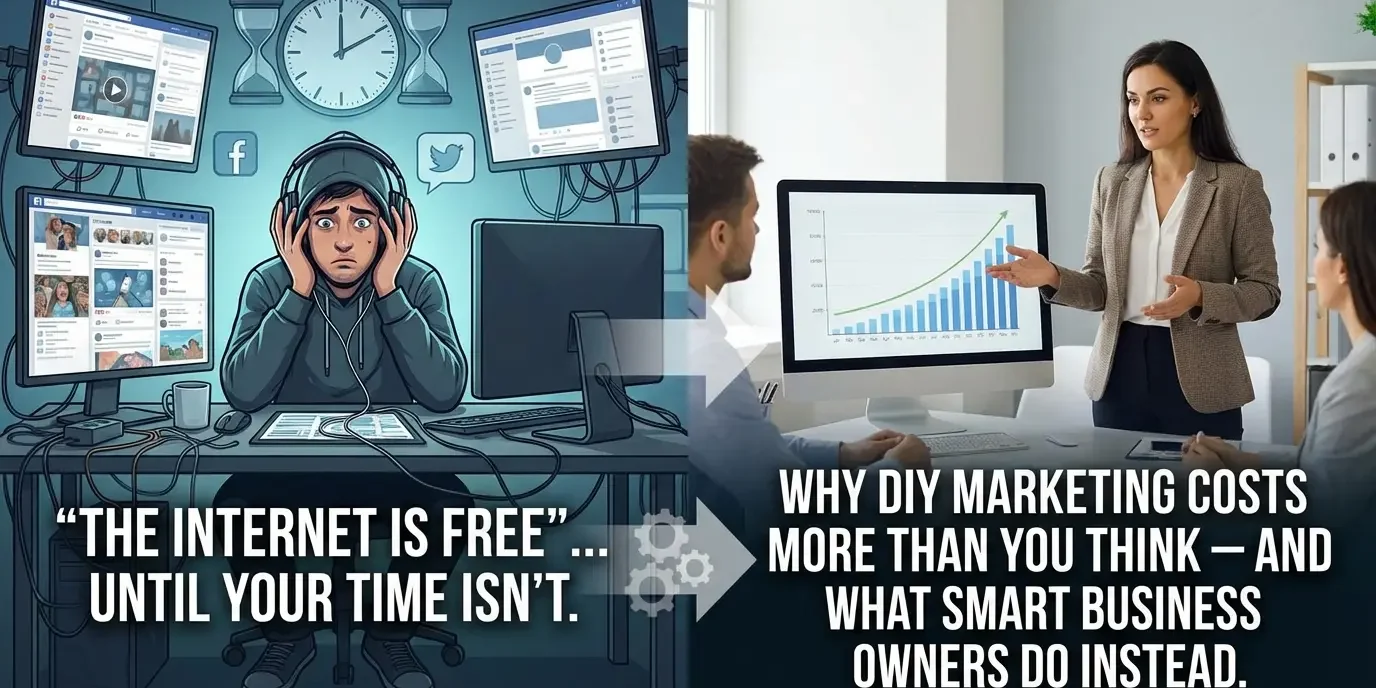
The Tools Are Free. The Results Aren’t.
If you’re a business owner who believes the internet is free — and that you should be able to handle your own marketing — you’re not entirely wrong.
Posting on social media costs nothing. Google accounts are free. Email platforms have starter plans. Website builders promise drag-and-drop success. And with global digital ad spending surpassing $740 billion in 2025 — accounting for over 75% of all advertising spend worldwide — there has never been more opportunity to reach customers online.
So why hire a digital marketing agency?
Because while the tools may be free, effective marketing never is. And the real cost most DIYers underestimate isn’t the software subscription or the ad budget — it’s their own time, energy, and the compounding cost of missed opportunities.
The data tells a clear story: 71% of small businesses handle all of their marketing themselves, yet businesses that blend in-house efforts with professional agency support report 2.5 times more marketing success than those going it alone. That gap isn’t about effort. It’s about expertise, strategy, and leverage.
DIY Marketing Feels Cheaper — At First
For many business owners, doing it yourself feels logical:
“I can post on Facebook myself.” “I watched a YouTube video on SEO.” “I boosted a post for $20.” “Google Ads lets me set my own budget.”
The reasoning makes sense on the surface. Why pay someone else to do something you can technically do for free? But the problem isn’t effort — it’s efficiency. And in digital marketing, the gap between activity and results is where businesses lose the most money.
DIY marketing commonly leads to inconsistent posting that confuses algorithms and reduces organic reach, trial-and-error ad spend without proper tracking or attribution, no clear strategy connecting marketing activities to business goals, campaigns that look busy on the surface but don’t produce measurable leads or revenue, and a reactive approach — chasing trends instead of building systems.
Consider this: 44% of businesses lack any quantitative understanding of their marketing’s impact. They’re spending time and money but can’t tell you what’s working, what’s not, or where the next customer is coming from. That’s not marketing — it’s guessing with a budget.
The internet rewards expertise, not activity. And in 2025, where the average Google Ads click costs $5.26 and the average cost per lead is $70.11, the margin for error is razor-thin.
71% of small businesses do all their marketing themselves — but those who partner with agencies report 2.5x more success. The tools are accessible to everyone. The results aren’t.
Your Time Is Your Most Expensive Resource
Let’s talk about the cost no one calculates — and the one that matters most.
Small business owners spend an average of 20 hours per week on marketing activities. That’s essentially half of a standard work week dedicated to tasks outside their core expertise — learning platform algorithms, writing ad copy, designing graphics, managing social accounts, troubleshooting campaign performance, and trying to interpret analytics dashboards that weren’t designed for non-marketers.
On social media alone, 43% of small business owners spend at least 6 hours per week just managing their social channels. Add in email marketing, website updates, SEO efforts, and paid advertising management, and you can quickly see how marketing becomes a second full-time job.
Now consider what those hours actually cost. If your time as a business owner is worth $100 to $300 or more per hour — based on the revenue you generate when you’re focused on your core business — then 20 hours per week of DIY marketing represents $2,000 to $6,000 or more in lost productivity. Every week. That’s $8,000 to $24,000 per month in opportunity cost, not including the ad dollars spent on underperforming campaigns.
When a business owner spends those hours learning algorithms, writing ad copy, designing graphics, managing platforms, and troubleshooting performance, they are not closing deals, serving existing customers, improving operations, building strategic partnerships, or directly growing revenue.
DIY marketing doesn’t just consume time — it consumes the exact time that generates the most value for your business. The hours you spend trying to figure out Facebook’s latest algorithm change or why your Google Ads campaign isn’t converting are hours you’re not spending on the work that only you can do.
At a certain point, DIY marketing becomes the most expensive option on the table — not the cheapest.
Free Tools Still Require Paid Expertise
The internet gives everyone access to powerful tools. It does not give everyone mastery.
Google Ads, Meta’s advertising platform, SEO tools, CRM systems, email marketing platforms, analytics dashboards — these are sophisticated, constantly evolving, algorithm-driven ecosystems that reward deep expertise and punish casual users.
The complexity is staggering. Google Ads operates across Search, Display, YouTube, Gmail, Discover, and Maps — with AI-powered campaign types like Performance Max and AI Max for Search that require strategic understanding to use effectively. Facebook offers over 1,500 targeting parameters and has fundamentally changed its approach to audience targeting in 2025, retiring several detailed targeting options and pushing advertisers toward AI-driven optimization. SEO now involves not just keywords and content but technical optimization, site speed, mobile performance, schema markup, and adapting to AI-generated search overviews.
The consequences of inexperience are expensive. The average small business spends between $1,000 and $10,000 per month on Google Ads alone, yet without proper keyword strategy and negative keyword management, businesses waste up to 40% of their ad budget on irrelevant clicks. Globally, an estimated $84 billion in digital ad spend is lost to ad fraud annually. And beyond fraud, structural inefficiencies in how businesses use their marketing technology lead to an additional 12% of ad budgets being wasted, according to research from Forrester.
A full-service digital marketing agency doesn’t just use the tools — they understand how the tools work together as a system. They know which platforms matter for your specific industry and audience, how to structure campaigns that feed data back into optimization, what to ignore amid the constant noise of new features and trends, and how to avoid the costly mistakes that eat up budgets before delivering a single qualified lead.
That accumulated expertise is what you’re paying for — not the clicks or posts. And it’s why 70% of advertisers report Google Ads as their highest-ROI channel when campaigns are properly managed, while poorly managed campaigns drain budgets with little to show.
Strategy Beats Guesswork Every Time
This is where the DIY approach breaks down most dramatically.
DIY marketing almost always starts with tactics. “Let’s run a Facebook ad.” “Let’s post more on Instagram.” “Let’s try TikTok.” “Let’s boost this post for $20.” These are actions without architecture — individual moves without a game plan.
Professional agencies start with strategy. Before a single ad runs or a single post goes live, the foundational questions get answered: Who is your ideal customer, and what do they actually care about? Where in the buying journey do they make decisions, and which platforms influence those decisions? What message moves them from interest to action? What happens after the lead comes in — is there a system to follow up, nurture, and convert? How do all the marketing channels work together to create a cohesive customer experience?
This strategic foundation is why 92% of top-performing agencies prioritize brand storytelling and narrative, while most DIY marketers jump straight to tactical execution. It’s also why 82% of small businesses that use multiple coordinated marketing channels report better results — the coordination is what creates compounding returns, and coordination requires strategy.
Without strategy, even “free” marketing becomes expensive noise. You can post on social media every day, run ads on Google and Facebook, send weekly emails, and still see no meaningful growth — because the pieces aren’t connected, the messaging isn’t consistent, and there’s no system turning attention into revenue.
Strategy is what transforms marketing from a cost into an investment. And strategy is what separates the businesses that grow from the ones that stay stuck.
Full-Service Agencies Create Leverage
One of the most compelling reasons to work with an agency isn’t just expertise — it’s leverage.
Consider what it would cost to build an in-house marketing team. A competent social media manager, an advertising specialist for Google and Facebook, a web developer, an SEO expert, a copywriter, and a strategist to coordinate all of it. You’re looking at multiple six-figure salaries in total, plus benefits, training, management overhead, software subscriptions, and the inevitable costs of turnover — all before a single campaign produces a result.
A full-service digital marketing agency gives you a coordinated team of specialists focused on one goal — your growth — without the payroll, training, or turnover headaches. And because agencies work across multiple clients and industries, they bring pattern recognition and cross-pollinated insights that no single in-house hire can match. They’ve seen what works in your industry, what’s failing in adjacent markets, and what emerging opportunities look like before they become crowded.
This is why 75% of small businesses prefer working with boutique marketing agencies — they get the agility and attention of a dedicated team with the breadth of expertise that would be impossible to build internally at the same cost. And it’s why 68% of small businesses that outsource their marketing see measurable growth within the first six months.
The math is straightforward. For less than the cost of a single full-time marketing employee, you get an entire team with diverse skill sets, proven processes, professional tools, and accountability for results. That’s not an expense — that’s leverage.
The Algorithm Changes. The Expertise Gap Widens.
One reality that DIY marketers consistently underestimate is the pace of change.
In 2025 alone, Google launched AI Max for Search campaigns, Meta retired several key targeting options and pushed advertisers toward broader AI-driven optimization, social media algorithms continued shifting toward short-form video and AI-curated content feeds, and privacy regulations and cookie deprecation reshaped how audience targeting and attribution work across every platform.
Each of these changes requires understanding, adaptation, and strategic response. For a business owner trying to keep up while also running their actual business, it’s an impossible task. The platforms change faster than any individual can learn them — and the cost of being behind is measured in wasted spend and missed opportunities.
For agencies, staying current isn’t a side project — it’s the core job. Marketing professionals spend their days inside these platforms, attending industry conferences, analyzing campaign data across dozens of clients, and adapting strategies in real time. The expertise gap between a dedicated marketing professional and a business owner who “does marketing on the side” widens every year as the platforms become more complex and more competitive.
This is exactly why businesses using AI-powered tools and agency support are seeing dramatically better results. Research shows that 65% of industries saw improved conversion rates in 2025 — but those improvements went overwhelmingly to advertisers with the expertise to leverage AI bidding, creative optimization, and data-driven strategy. The rising tide doesn’t lift all boats equally — it lifts the ones with experienced captains.
Marketing Works Best When You Stay in Your Lane
The most successful business owners understand one key truth: you don’t grow by doing everything yourself. You grow by doing what you do best and partnering with people who do the rest.
You’re great at what you do. That’s why customers hire you. Whether you run a medical spa, an auto dealership, an entertainment venue, or a professional services firm — your expertise is what drives your business. Your customers don’t hire you because of your Facebook posts. They hire you because of the value you deliver.
A marketing agency is great at creating demand for your services, generating qualified leads that are ready to convert, building visibility and brand authority in your market, turning website traffic and ad clicks into actual revenue, and creating the systems that make growth predictable rather than accidental.
When everyone stays in their lane, results happen faster and with far less stress. You focus on delivering exceptional service to your customers. The agency focuses on making sure a steady stream of new customers keeps coming through the door. That division of labor isn’t a luxury — it’s how businesses scale.
“Free” Marketing Often Costs the Most
Let’s add up the real cost of DIY marketing for a typical small business owner:
The time cost alone — 20 hours per week at even a conservative $150/hour — represents $156,000 per year in lost productive capacity. Add in wasted ad spend from campaigns without proper strategy, optimization, or tracking. Layer on the missed opportunities — the leads that went to competitors because your follow-up was too slow, your targeting was too broad, or your messaging didn’t resonate. Factor in the growth plateau that comes from inconsistent execution and reactive decision-making.
DIY marketing often leads to burnout — because you’re working in your business and trying to master an entirely separate discipline at the same time. It leads to inconsistent results because marketing done sporadically between other responsibilities can’t build the momentum that drives compounding growth. It leads to wasted ad spend because platforms are designed to keep you spending, not to optimize your results. And it leads to growth plateaus because without strategy, data, and expertise, you hit a ceiling that effort alone can’t break through.
Hiring a full-service agency isn’t an expense — it’s an investment in focus, clarity, and momentum. It’s the decision to stop trying to do everything at a mediocre level and start doing the right things at a professional level.
The ROI of Professional Marketing: What the Data Shows
The numbers make a compelling case for professional marketing support:
Businesses that outsource to professional marketing agencies see 42% higher ROI within the first year compared to DIY marketers. Companies using CRM systems alongside professional marketing see a 29% increase in sales, a 34% improvement in sales productivity, and up to a 300% increase in lead conversion rates. The average business earns $2 in revenue for every $1 spent on properly managed Google Ads campaigns — but poorly managed campaigns see a fraction of that return. Facebook Ads deliver an average ROI of approximately 4x ad spend when campaigns are strategically optimized, with 70% of advertisers reporting positive ROI within three months. Regular campaign optimization by experienced professionals can improve ROI by over 50% compared to set-it-and-forget-it approaches.
The difference between DIY and professional marketing isn’t just about doing the same things better — it’s about doing fundamentally different things. It’s the difference between boosting a post and building a conversion funnel. Between checking your analytics once a month and optimizing campaigns daily. Between guessing what works and knowing what works because the data tells you.
CRM + Agency: The Growth Infrastructure
One critical piece that ties everything together is a CRM — Customer Relationship Management system. Without it, even the best marketing campaigns lose their impact because leads fall through the cracks, follow-up is inconsistent, and there’s no system to track what’s actually generating revenue.
The data is overwhelming: businesses earn an average of $8.71 for every $1 spent on CRM software. Companies using CRM effectively see up to a 27% increase in customer retention and a 32% reduction in marketing costs. And 97% of businesses using a CRM met or exceeded their sales goals.
When you combine professional agency marketing with a well-implemented CRM, you create a complete growth infrastructure — one where every ad dollar is tracked from click to closed deal, every lead is followed up with systematically, every customer is segmented for targeted ongoing marketing, and every campaign decision is informed by real revenue data, not vanity metrics.
This is the kind of system that separates businesses that grow year over year from those that stay stuck at the same level indefinitely.
Final Thought
The internet is free.
Your time isn’t. Your expertise isn’t. Your growth shouldn’t be left to guesswork.
The most cost-effective decision isn’t doing everything yourself — it’s partnering with people who do this every day, so you can do what you do best. The data consistently shows that businesses investing in professional marketing support grow faster, waste less, convert more, and build more sustainable revenue than those trying to figure it all out on their own.
Every hour you spend wrestling with Facebook’s algorithm or trying to decode Google Ads reports is an hour you’re not spending on the work that built your business in the first place. And every month without a strategic, professionally managed marketing system is a month your competitors — the ones who did invest in professional support — are pulling further ahead.
So do the last thing you need to do yourself — give The Baer Edge a call today.
We’re a full-service digital marketing agency that handles everything from strategy and ad management to SEO, social media, email marketing, CRM implementation, and website development — so you can stay focused on running your business while we focus on growing it.
Sources and References
- Wix & VistaPrint — Small Business Marketing Survey (2024)
- SimpleTexting — Small Business Marketing Channel Research (2024)
- Constant Contact — Small Business Marketing Time Study
- VerticalResponse — Small Business Social Media Time Survey
- WordStream/LocaliQ — 2025 Google Ads Benchmarks Report
- eMarketer — Global Ad Spending Forecast (2025)
- Forrester Consulting — Marketing Technology Efficiency Research
- HubSpot — Agency ROI Comparison Study
- Clutch — Small Business Outsourcing Report (2025)
- Nucleus Research — CRM ROI Benchmarks
- Salesforce — CRM Sales Impact Statistics
- Juniper Research — Digital Ad Fraud Analysis