
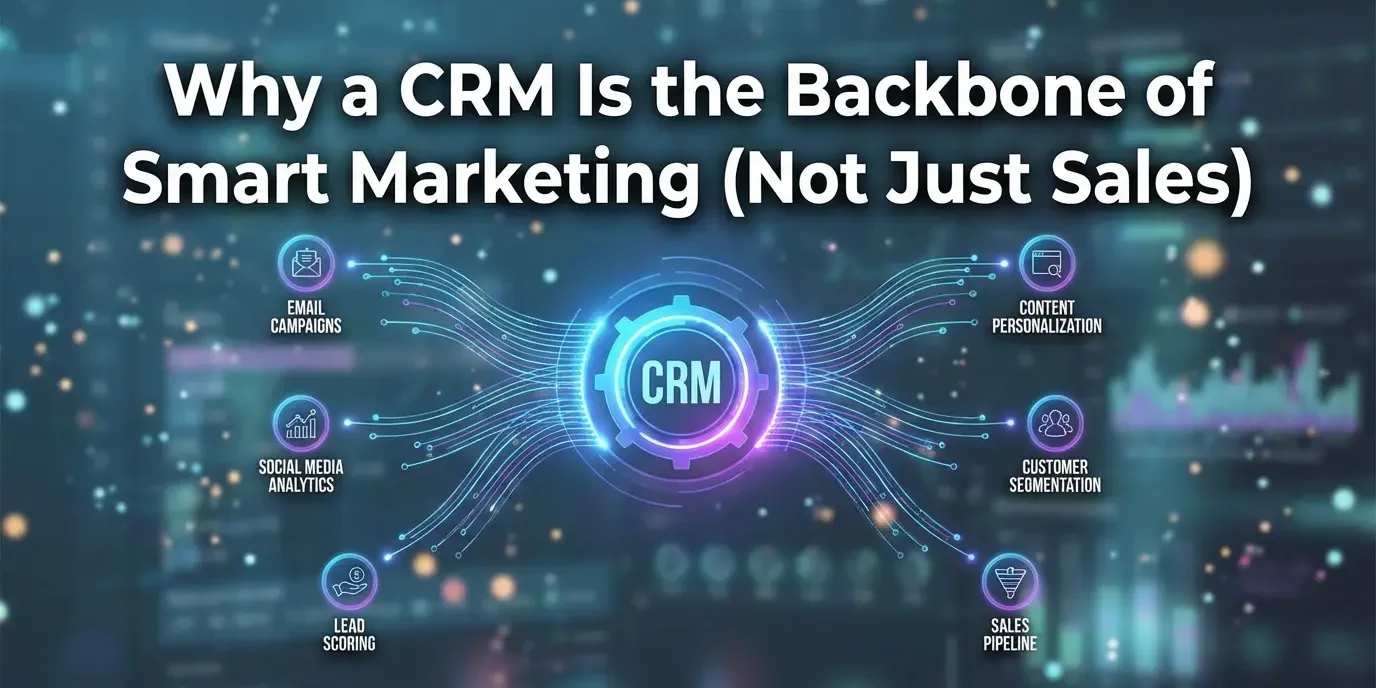
Introduction: Your CRM Is Worth More Than You Think
Many businesses think of a CRM (Customer Relationship Management system) as just a sales tool — a place to dump leads and set follow-up reminders. That mindset leaves a significant amount of revenue on the table.
The global CRM market has reached $112.91 billion in 2025, growing at a compound annual rate of 12.8% and projected to hit $262.74 billion by 2032. That kind of growth doesn’t happen because businesses are buying glorified address books. It happens because CRM systems have become the strategic command center for both sales and marketing — the central infrastructure that connects lead generation, customer engagement, retention, and revenue.
The numbers tell the story: businesses earn an average of $8.71 for every $1 spent on CRM software. Companies using CRM see a 29% increase in sales, a 34% improvement in sales productivity, and up to a 300% increase in lead conversion rates. And 97% of businesses that use a CRM met or exceeded their sales goals in the past year.
Yet 40% of salespeople still use informal methods like spreadsheets and email to store customer data, and 22% of sales professionals aren’t even sure what a CRM actually does. The gap between CRM adopters and those still running on spreadsheets and memory is widening every quarter — and it’s showing up in their bottom lines.
A CRM isn’t just about closing the next deal. It’s about building long-term relationships, understanding your audience, and marketing smarter at every stage of the customer journey. If you’re serious about growth, your CRM should be at the center of both your sales and marketing strategy.
Businesses earn $8.71 for every $1 spent on CRM — and companies using CRM are 86% more likely to exceed their sales goals. This isn’t optional software. It’s foundational infrastructure.
A CRM Makes Lead Follow-Up Consistent, Fast, and Revenue-Generating
Let’s start with the most immediate impact: leads.
Without a CRM, follow-up is typically inconsistent, dependent on memory or sticky notes, lost in email inboxes, and forgotten once things get busy. This isn’t just an organizational inconvenience — it’s a direct revenue leak. Research shows that 51% of leads are never contacted at all, and approximately 71% of internet leads are wasted due to poor follow-up. The average business takes a staggering 42 hours to respond to a new lead.
That delay is devastating. Responding to a lead within 5 minutes increases conversion rates by up to 100x compared to waiting 30 minutes. Calling a lead within the first 60 seconds boosts conversions by 391%. And 78% of customers buy from the first company that responds — meaning every minute of delay isn’t just a missed opportunity, it’s a gift to your competitor.
A CRM solves this systematically. Every lead is captured automatically from web forms, ad platforms, phone calls, and chat. Follow-ups are scheduled, tracked, and triggered by rules — not by memory. Real-time notifications alert your team the moment a new lead enters the system. Automated workflows can send an immediate acknowledgment while routing the lead to the right salesperson based on geography, service interest, or availability.
The result is that no opportunity slips through the cracks, and your team responds when lead interest is at its peak. Research from Harvard Business Review confirms that companies responding within one hour are 7x more likely to qualify a lead than those who wait even two hours. A CRM makes that speed repeatable, consistent, and scalable — instead of accidental.
Your Existing Customers Are Your Best Marketing Asset
This is where most businesses miss the real value of a CRM.
Once a customer converts, many companies stop tracking them beyond billing. They move on to chasing the next lead. That’s a costly mistake, because returning customers spend 67% more than new customers on average, and marketing to existing customers is significantly less expensive with higher conversion rates than acquiring new ones.
CRM data shows that 44% of companies have identified increasing revenue from pre-existing customers as a top priority — yet many still lack the systems to act on it effectively. A CRM transforms your customer base from a forgotten list into a living, segmented marketing database.
With a properly utilized CRM, you can segment customers by service type, industry, purchase history, or engagement level. You can identify upsell and cross-sell opportunities based on what customers have already bought and what they’re likely to need next. You can create targeted email campaigns for specific customer segments instead of sending generic blasts — and CRM-driven personalized email campaigns generate a 14% higher click-through rate than non-personalized ones. You can track engagement patterns to identify at-risk customers before they churn, and trigger automated re-engagement sequences to bring dormant customers back.
The retention impact alone is substantial. Companies that effectively use CRM tools to engage customers experience a 27% increase in customer retention rates. And 47% of CRM users report a significant improvement in both customer retention and customer satisfaction after adoption. Given that 94% of customers are likely to purchase again from the same source, every percentage point of improved retention translates directly to revenue.
CRM systems improve customer retention by up to 27% — and returning customers spend 67% more than new ones. Your existing customer base is your most profitable marketing channel. A CRM unlocks it.
Better Data Means Better Marketing Decisions
Marketing without data is guessing. And in 2025, guessing is expensive.
A CRM gives you insight into which campaigns and channels bring the best leads, which leads actually convert into paying customers (and how long that takes), how long your real sales cycle is — not your assumed one, what messaging resonates at different stages of the buyer’s journey, and which customer segments are most profitable over time.
Instead of asking “What should we post or send?” you can ask data-driven questions: “What has worked before?” “Who is most likely to buy again?” “Where are leads getting stuck in our funnel?” “Which marketing channel delivers the lowest cost per acquisition?”
The impact of this data-driven approach is measurable. CRM systems improve sales forecasting accuracy by an average of 42%, and 54% of companies leveraging marketing analytics report above-average profits. Businesses using CRM saw a 41% increase in sales revenue and a 32% reduction in marketing costs — because they stopped spending on tactics that weren’t working and doubled down on what was.
Sales reporting improves by up to 42% with effective CRM implementation, giving leadership real visibility into pipeline health, campaign attribution, and revenue forecasting. This isn’t just useful for sales managers — it’s the data marketing teams need to justify budget, prove ROI, and continuously optimize their strategy.
Personalization at Scale
Modern consumers expect personalized experiences. According to Deloitte’s 2024 research, nearly 75% of consumers are more likely to purchase from companies that offer personalized experiences — and they spend approximately 37% more with brands that deliver them. But personalization without a CRM means manual work that doesn’t scale.
A CRM makes personalization systematic and automated. You can send emails triggered by specific behaviors — a website visit, a service inquiry, a completed purchase — rather than blasting the same message to your entire list. You can trigger marketing campaigns after specific lifecycle events, such as a one-year customer anniversary, an upcoming renewal date, or a period of inactivity. You can customize messaging by industry, service interest, location, or engagement history — automatically.
The technology has leaped forward with AI integration. In 2025, 81% of organizations are predicted to use AI-powered CRM systems, and 65% have already adopted generative AI features within their CRM. Businesses using AI in their CRM are 83% more likely to exceed their sales goals, and AI-driven lead scoring can increase conversion rates by up to 20% by predicting which leads are most likely to convert.
AI-powered CRM capabilities include automated lead scoring that prioritizes your best opportunities, predictive analytics that forecast which customers are likely to buy again (or churn), intelligent content recommendations for email and messaging sequences, chatbots that provide instant lead engagement 24/7, and dynamic segmentation that automatically groups contacts based on evolving behavior.
The result is marketing that feels relevant and personal to each recipient — not generic or intrusive — delivered at scale without requiring your team to manually customize every touchpoint.
Alignment Between Sales and Marketing
One of the biggest growth killers is when sales and marketing operate in silos. Marketing generates leads and claims success. Sales says the leads are unqualified. Neither team has visibility into the other’s data, and finger-pointing replaces collaboration. This disconnect costs businesses real revenue.
A CRM aligns both teams by creating a single shared source of truth for every contact, lead, and customer interaction. Research shows that 78% of sales leaders believe CRM systems enhance collaboration between sales and marketing teams, and 73% of marketers actively use their company’s CRM to access sales prospect and lead data for improved targeting and insights.
With a shared CRM, both teams can agree on what a “qualified lead” actually looks like — documented in the system with clear criteria, not debated in meetings. Marketing can see which leads actually convert to revenue and optimize campaigns accordingly. Sales can see which campaigns and content a lead engaged with before entering the pipeline, giving them context for more relevant conversations. Attribution becomes clear: you can trace a closed deal back through the entire journey from first marketing touch to final sale.
When sales and marketing share data, messaging improves, follow-up improves, and conversions improve. More than two-thirds of companies now compete primarily on customer experience — up from just 36% in 2010 — and delivering that experience requires seamless coordination between every team that touches the customer. A CRM is the infrastructure that makes that coordination possible.
A CRM Isn’t Optional Anymore — It’s Foundational
In today’s market, relying on spreadsheets, email inboxes, or memory isn’t just inefficient — it’s a competitive liability. The data makes this clear: 91% of companies with 10 or more employees now use CRM systems, 87% of those are cloud-based, and 71% of small businesses have adopted CRM within their first five years of operation.
The businesses that haven’t adopted CRM are increasingly the outliers — and they’re paying for it in lost leads, poor retention, and unmeasurable marketing spend.
A CRM protects your leads and customer data in a centralized, accessible system — not scattered across individual inboxes and devices. It scales with your business, supporting a growing team, expanding client base, and increasingly complex marketing operations. It improves customer retention through systematic engagement and personalized communication. It turns marketing from a cost center into a measurable investment with clear attribution and ROI. And it saves your team significant time — most businesses report their CRM saves employees 5 to 10 hours per week by eliminating manual data entry and duplicate work.
At its core, a CRM isn’t just software — it’s infrastructure. It supports every campaign, every follow-up, every customer touchpoint, and every relationship you build. It’s the system that connects your marketing spend to your revenue results.
The AI-Powered CRM: What’s Changed in 2025
If you evaluated CRM systems a few years ago and decided they were too complex or not worth the investment, it’s time to look again. The CRM landscape has transformed dramatically.
Cloud-based deployment now accounts for 87% of all CRM systems, making them more accessible, affordable, and easier to implement than ever. Mobile CRM gives your team access to customer data, lead notifications, and follow-up tools from anywhere — critical for businesses with field sales teams or service providers on the go.
AI integration is the biggest shift. CRM platforms now offer features that were science fiction five years ago: automated lead scoring that tells you which prospects to prioritize, AI-generated email drafts and follow-up suggestions, predictive churn analysis that flags at-risk customers before they leave, intelligent workflow automation that handles routine tasks without human intervention, and conversational AI that engages leads instantly via chat or text.
Companies that use AI-driven CRM systems see a 30–50% improvement in response times, 15% increases in repeat sales and customer retention, and over 40% improvement in sales forecast accuracy. The technology is no longer reserved for enterprise corporations — platforms like HubSpot, Salesforce, Zoho, and others offer AI-powered features at price points accessible to small and mid-sized businesses.
CRM by the Numbers: Key Statistics for 2025
| Metric | Statistic |
|---|---|
| Average ROI | $8.71 for every $1 spent on CRM |
| Lead Conversion Increase | Up to 300% with CRM implementation |
| Sales Revenue Increase | 29% average improvement |
| Sales Productivity Improvement | 34% average improvement |
| Customer Retention Increase | Up to 27% improvement |
| Sales Forecast Accuracy | 42% improvement |
| Marketing Cost Reduction | 32% average decrease |
| Time Saved Per Employee | 5–10 hours per week |
| Sales Goal Achievement | 97% of CRM users met or exceeded goals |
| AI Adoption in CRM | 81% of organizations using AI-powered CRM in 2025 |
| Global CRM Market Size (2025) | $112.91 billion |
| Projected CRM Market (2032) | $262.74 billion |
Final Thought: Stop Leaving Growth to Chance
If your business is spending money to attract leads but not investing in a CRM to manage and market to them effectively, you’re leaving growth to chance. The data is overwhelming: businesses with CRM systems convert more leads, retain more customers, reduce marketing costs, and grow revenue faster than those without.
The businesses that win in 2025 don’t just generate leads — they track, nurture, segment, and market intelligently across the entire customer lifecycle. And it all starts with the right CRM.
A CRM isn’t an expense. It’s the infrastructure that turns your marketing spend into measurable, compounding returns. Every campaign you run, every lead you capture, every customer relationship you build becomes more valuable when it’s supported by the right system.
If you’re considering a CRM, give us a call. We offer an economically priced CRM that can be customized to your needs — with the targeting, automation, and analytics capabilities your marketing and sales teams need to grow.
Sources and References
- Fortune Business Insights – Global CRM Market Size and Projections (2025–2032)
- Nucleus Research – CRM ROI Benchmarks
- Salesforce – CRM Sales Impact and Productivity Statistics
- Forrester Research – CRM Lead Conversion Data
- HubSpot – State of Marketing Report (2024–2025)
- Capterra – CRM User Impact Survey
- G2 – Winter 2025 Grid Report for CRM
- Harvard Business Review – Lead Response Time Study
- Deloitte – Power of Personalization in Marketing (2024)
- Aberdeen Group – CRM Customer Retention Research
- WebFX – CRM Performance Metrics
- Freshworks – CRM Time Savings Data
- CRM.org – CRM Statistics and Market Insights (2025)
- The Sales Collective – Customer Retention Statistics (2025)