
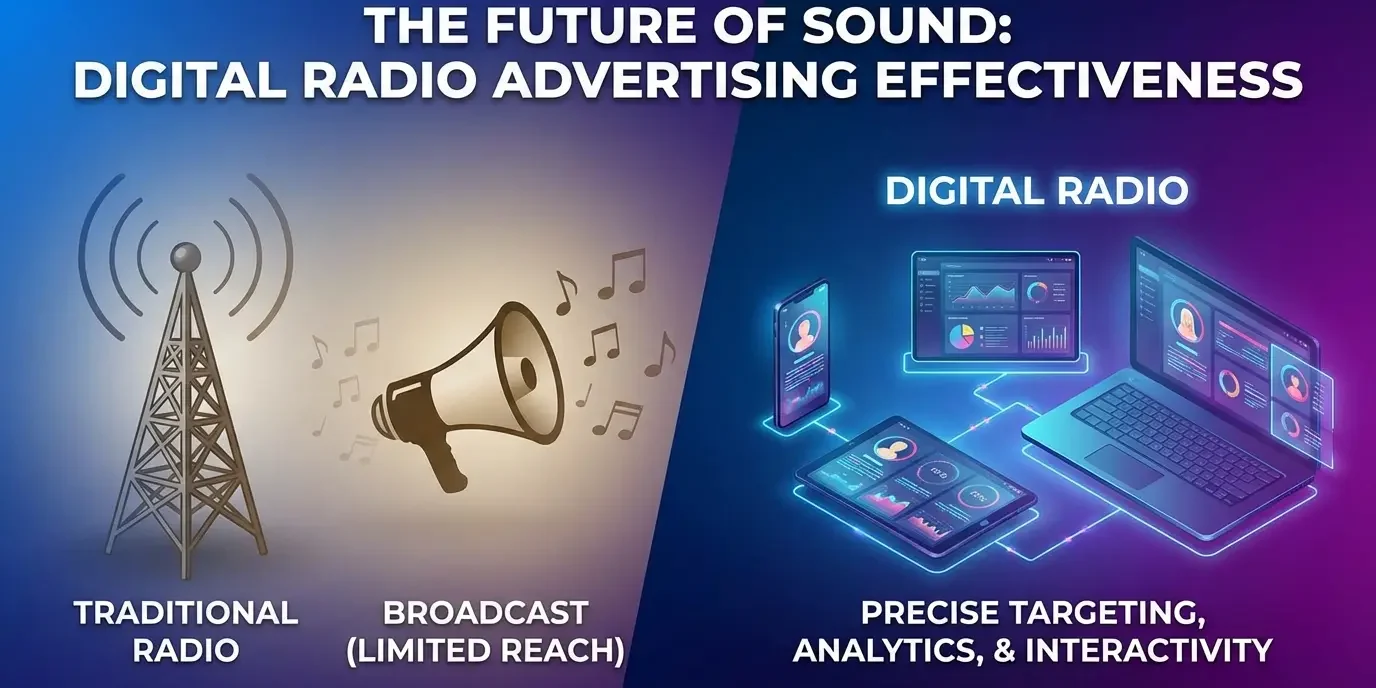
Introduction: The Audio Advertising Landscape Has Shifted
Radio advertising has been a staple of local and national marketing for decades. For generations, brands relied on AM/FM radio to reach broad audiences during commutes, work hours, and leisure time. But the audio landscape in 2025 looks dramatically different from even five years ago.
Digital audio — including streaming music platforms, podcasts, and internet-based radio services — has exploded in growth, fundamentally reshaping how people listen and how advertisers reach them. Spotify alone now has 678 million monthly active users globally, with over 393 million on ad-supported tiers. Podcasts reach more than 42% of Americans on a monthly basis, up from just 12% a decade ago. And the global podcast industry is valued at approximately $40 billion in 2025, with worldwide podcast ad spending hitting $4.5 billion.
Meanwhile, traditional AM/FM radio listenership continues its gradual decline, dropping from 88.3% of Americans in 2019 to approximately 84% by recent estimates. Local radio ad revenue is projected at $12.3 billion in 2025, but the growth story is entirely on the digital side: radio’s digital revenue hit a record $2.3 billion in 2025 — now representing 24.4% of total radio industry revenue — growing at a compound annual rate of 8.3% since 2022, while core traditional radio advertising declined 2.2% over the same period.
The message from the industry is clear. As Borrell Associates CEO Gordon Borrell put it, digital has moved from being an add-on to becoming radio’s primary growth engine. For advertisers, the question is no longer whether to invest in digital audio — it’s how aggressively to shift.
Digital audio ad revenue is growing at 8.3% annually while traditional radio ad revenue is declining 2.2%. The gap widens every year — and the smartest advertisers are following the listeners.
1. What Is Digital Radio Advertising?
Before comparing the two, it’s helpful to define what digital radio advertising encompasses in 2025. The term covers several formats and platforms.
Streaming Music Platforms like Spotify, Pandora, Amazon Music, and Apple Music deliver audio ads between songs or within curated playlists. Spotify, the market leader, is projected to generate $2.08 billion in global ad revenue and $1.35 billion in U.S. ad revenue alone in 2025. Its ad-supported user base of 393+ million listeners provides massive scale for advertisers.
Podcasts are one of the fastest-growing segments in audio advertising. With over 3.1 million podcast titles available and 150+ million monthly podcast listeners in North America alone, podcast ads — especially host-read formats — deliver uniquely high engagement and trust. YouTube has emerged as the number one platform for podcast consumption, with roughly one-third of listeners using it as their primary podcast source, followed by Spotify at approximately 25–27%.
Internet Radio and Digital Simulcast includes platforms like iHeartRadio, TuneIn, and SiriusXM’s streaming services, which deliver traditional radio-style content through digital channels with added targeting and measurement capabilities.
Smart Speaker Audio reaches listeners through devices like Amazon Echo and Google Nest. Research shows that 58% of consumers find smart speaker ads less invasive than ads on TV, print, or social media — making them a growing frontier for audio advertisers.
Unlike traditional AM/FM radio, which broadcasts a single signal to everyone within range, all of these digital audio channels share a common advantage: they leverage listener data to deliver targeted, measurable, and optimizable advertising.
2. Precision Audience Targeting
The most significant advantage digital radio holds over traditional radio is targeting precision.
Traditional Radio’s Limitations
Traditional radio advertising is inherently broad. You buy a time slot on a station, and your ad reaches whoever happens to be listening. While certain stations attract general demographic profiles — a classic rock station skews older, a Top 40 station skews younger — advertisers have no control over exactly who hears their message. There’s no way to target by income level, purchase behavior, specific interests, or geographic precision beyond the station’s general broadcast footprint.
Digital Radio’s Targeting Capabilities
Digital audio platforms offer granular targeting that mirrors what advertisers are accustomed to in social media and display advertising:
Demographic Targeting allows advertisers to reach specific age groups, genders, income brackets, and household compositions. Spotify’s ad-supported audience, for example, skews younger — 52% aged 18–34 — but the platform provides tools to target any demographic segment within its user base.
Interest and Behavioral Targeting is where digital audio truly separates itself. Platforms can target listeners based on the genres they stream, the podcasts they follow, the playlists they create, and even their mood or activity. If you sell fitness equipment, you can target listeners who regularly stream workout playlists or follow health and wellness podcasts. This behavioral data doesn’t exist in traditional radio.
Geo-Targeting enables advertisers to serve ads to listeners in specific cities, zip codes, or even neighborhoods — critical for local businesses like restaurants, automotive dealerships, entertainment venues, and medical spas that need to reach customers within a defined service area.
Device Targeting lets you optimize delivery across smartphones, desktops, smart speakers, and connected car systems. Mobile makes up 85% of streaming audio usage, and in-car streaming is growing at 18% year over year — both key touchpoints for reaching consumers during commutes and daily routines.
Retargeting and Sequential Messaging allow advertisers to follow up with listeners who have already heard an ad or interacted with a brand, building frequency and moving prospects through the funnel. Traditional radio has no mechanism for this.
The result is that every dollar spent on digital audio advertising goes toward reaching listeners who match your ideal customer profile — rather than broadcasting to the general public and hoping the right people are tuned in.
3. Superior Engagement and Ad Recall
Traditional radio is a passive, one-way medium. Your ad airs, and you have no idea whether the listener was paying attention, had the volume turned down, or switched stations during the commercial break.
Digital audio advertising delivers measurably higher engagement, and the data supports this across multiple dimensions.
The Recall Advantage
According to Nielsen Media Lab research, audio advertisements achieve a 24% higher recall rate than traditional display ads. On Spotify specifically, research shows that approximately 93% of the brain’s engagement with podcast content transfers directly into ad engagement — meaning listeners process ads with nearly the same attention they give the content itself.
Host-read podcast ads are particularly powerful: they increase listener trust by 58% compared to standard produced ads, and 69% of podcast listeners say host-read ads feel more authentic than other advertising formats. This trust translates directly into action — 60% of podcast listeners who heard an audio ad went on to complete a purchase, and 73% of U.S. podcast listeners report being receptive to sponsored messages.
The Engagement Advantage
Digital audio also supports interactive and actionable ad formats that traditional radio cannot. These include clickable companion banners that appear alongside audio ads on mobile, shoppable links embedded within podcast episodes, QR codes in video podcast formats, and direct response calls to action with trackable URLs and promo codes.
Research shows that 81% of listeners attentively engage with podcast ads, compared to just 63% who remain engaged during TV commercials. Younger listeners aged 18–34 prefer audio ads at a rate of 2:1 over traditional radio ads, and personalized audio ads increase engagement by 29%.
For advertisers, this means digital audio doesn’t just reach people — it reaches them in a state of active engagement where they’re more likely to listen, remember, and act.
81% of listeners attentively engage with podcast ads vs. 63% for TV commercials. Digital audio captures attention at a level traditional broadcast simply cannot match.
4. Cost-Effectiveness and Budget Flexibility
Traditional Radio’s Cost Structure
Buying ad space on traditional radio — especially during peak drive-time slots in major markets — requires significant upfront investment. In larger markets, advertisers can expect to spend $2,000 to $5,000+ per week for meaningful frequency, and rates are fixed regardless of whether your target audience is actually listening. There’s minimal flexibility to adjust mid-campaign, and smaller businesses often find that the cost of achieving meaningful frequency on traditional radio strains their budgets without guaranteeing results.
Digital Radio’s Economic Advantage
Digital audio advertising operates on performance-oriented pricing models that give advertisers far more control. The average podcast ad CPM ranges from $18 to $45, while streaming music platform CPMs can be even lower depending on targeting parameters. Spotify’s self-serve Ads Manager allows businesses to launch campaigns with budgets as low as $250 — a fraction of what traditional radio requires.
This cost flexibility is critical for small and mid-sized businesses. You can test a digital audio campaign with a modest budget, measure results, and scale up only what’s working — rather than committing thousands of dollars to a traditional radio buy with no performance data to guide optimization.
The ROI data reinforces this advantage: audio ads drive a 2.1x to 3.4x return on ad spend for most brands, and adding audio to cross-channel campaigns improves overall campaign recall by 17%. When you factor in the ability to target precisely and eliminate wasted impressions, the effective cost per engaged listener on digital audio is substantially lower than traditional radio for most advertisers.
5. Real-Time Analytics and Measurable Performance
Traditional Radio’s Measurement Problem
Traditional radio measurement relies on audience estimates — typically from surveys or portable people meters that sample a small fraction of the listening population. You can get a general sense of how many people a station reaches during a given daypart, but you cannot track whether a specific listener heard your ad, listened to it completely, or took any action as a result.
This measurement gap is a major frustration for data-driven marketers. As the RAB’s own benchmarking report notes, local advertisers continue to value radio’s branding power but see it as difficult to measure — and as a result, budgets are migrating toward digitally measurable campaigns.
Digital Radio’s Analytics Advantage
Digital audio platforms provide comprehensive, real-time analytics that make every campaign accountable:
Impressions tell you exactly how many times your ad was served to listeners — not an estimate, but an actual count.
Completion Rates show what percentage of listeners heard your ad in its entirety. Audio ads under 20 seconds achieve the best completion rates, and platform-level data lets you optimize creative length based on real performance.
Click-Through and Engagement Rates track how listeners interact with companion banners, shoppable links, promo codes, or other calls to action.
Conversion Tracking connects ad exposure to downstream actions — website visits, form submissions, purchases — giving you a direct line from ad spend to revenue.
Brand Lift Studies measure the impact of your campaign on awareness, consideration, and purchase intent through controlled exposure studies.
Cross-Platform Attribution tracks how audio ad exposure influences behavior on other channels and devices, providing a holistic view of your campaign’s impact.
This data allows you to optimize in real time — adjusting targeting, creative, frequency, and budget allocation based on what the numbers show. Traditional radio offers nothing comparable.
6. Wider Reach With Greater Precision
Traditional Radio’s Geographic Constraints
Traditional AM/FM radio is inherently limited by its broadcast signal. A local station reaches only the listeners within its coverage area, and national campaigns require buying time on dozens or hundreds of stations across markets — a logistically complex and expensive process with inconsistent measurement across each buy.
Digital Radio’s Scalable Reach
Digital audio transcends geographic limitations entirely. A campaign on Spotify, Pandora, or a podcast network can reach listeners in a single zip code or across the entire country with equal targeting precision. You can run a hyper-local campaign targeting your city’s metro area, or scale to regional and national audiences without the logistical burden of coordinating with multiple station groups.
The reach of digital audio is massive and growing. U.S. digital audio listeners are projected to exceed 230 million in 2025. Podcasts alone reach over 42% of all Americans monthly. Streaming audio now accounts for more than 75% of modern music consumption, and time spent listening on mobile devices continues to climb — with 48% of U.S. adults listening to digital audio during their commute and average in-car listening time reaching 50 minutes per day.
For local businesses, the combination of broad digital reach with precise geo-targeting is particularly powerful. You can reach every potential customer within your service area who fits your demographic and behavioral profile — something traditional radio’s blunt broadcast signal simply cannot achieve.
7. Enhanced Listener Experience and Ad Receptivity
Traditional Radio’s Relevance Problem
Traditional radio listeners have no control over the ads they hear. When an irrelevant commercial comes on — an ad for a product they’d never buy, a service not available in their area, or a brand that doesn’t match their interests — it’s a disruption that creates negative associations. Listeners respond by tuning out, switching stations, or simply ignoring the entire commercial break.
Digital Radio’s Personalization Advantage
Digital audio platforms deliver ads that are contextually relevant to the individual listener — based on their demographics, interests, listening habits, and location. This relevance dramatically improves ad receptivity.
Research shows that ads matched to a listener’s mood or activity increase response rates by 22%, and ads that align with the tempo or style of the content increase recall by 31%. When audio ads are relevant and well-targeted, 46% of listeners say they don’t mind hearing them — especially when ads are short and contextually appropriate.
The median age of podcast listeners is 34 (compared to 47 for radio and 57 for TV), meaning digital audio naturally skews toward younger, more engaged, and more commercially active demographics. And podcast listeners tend to be more affluent than average digital users, making them a high-value audience for advertisers.
Perhaps most importantly, the relationship between podcast hosts and their audiences creates a trust dynamic that traditional radio’s rotating commercial breaks cannot replicate. When a trusted podcast host personally recommends a product, 54% of listeners are more likely to consider that brand — a level of influence that comes from authentic engagement, not interruptive broadcasting.
8. AI-Powered Audio Advertising: The 2025 Frontier
Artificial intelligence is transforming digital audio advertising in ways that further widen the gap with traditional radio. AI enables real-time personalization of ad creative based on listener data, predictive targeting that identifies high-value audience segments before spend is committed, dynamic ad insertion that serves the right message at the right moment within content, automated campaign optimization that continuously improves performance, and programmatic buying that matches advertisers with premium inventory at scale.
Spotify’s ad revenue has grown nearly fivefold in eight years — from $451 million in 2017 to an estimated $2.08 billion in 2025 — driven in large part by investments in programmatic audio, AI-driven personalization, and interactive ad formats. Nearly 25% of Spotify’s overall revenue now comes from programmatic audio ads, and the platform continues to roll out features like shoppable links and interactive audio that push the boundaries of what audio advertising can achieve.
Traditional AM/FM radio has no infrastructure for AI-driven optimization, programmatic buying, or real-time personalization. The technology gap between digital and traditional audio advertising grows wider every quarter.
Digital Radio vs. Traditional Radio: Side-by-Side Comparison
| Factor | Digital Radio Advertising | Traditional Radio Advertising |
|---|---|---|
| Targeting | Granular: demographics, behavior, interests, geo, device, retargeting | Broad: station format and time slot only |
| Cost Structure | CPM/CPC-based; flexible budgets starting at $250; pay for targeted impressions | Fixed time-slot buys; high minimums in major markets; pay for broadcast reach |
| Ad Recall | 24% higher recall than display; 93% brain engagement transfer on podcasts | Estimated reach; no verification of attention or recall |
| Engagement | Interactive: clickable, shoppable, promo codes; 81% attentive engagement | Passive: one-way broadcast; no interaction mechanism |
| Measurability | Real-time: impressions, completion rates, CTR, conversions, brand lift | Estimated: survey-based audience ratings; delayed reporting |
| Flexibility | Real-time optimization; A/B testing; dynamic creative; adjust mid-campaign | Locked once scheduled; limited ability to change mid-buy |
| Reach | 230M+ U.S. digital audio listeners; global via internet; scalable local-to-national | Geographically constrained by broadcast signal |
| Audience Demographics | Median age 34; skews younger, more affluent, more commercially active | Median age 47; broad but aging listener base |
| AI Integration | Programmatic buying, predictive targeting, dynamic insertion, personalization | Minimal technology integration |
| Trust & Authenticity | Host-read podcast ads increase trust 58%; 69% find them more authentic | Station personalities can build trust but no data on individual listener response |
Where Traditional Radio Still Has a Role
Traditional radio is not dead — and it’s important to acknowledge its remaining strengths. AM/FM radio still reaches approximately 84% of Americans, and it remains the dominant audio medium during commutes in markets where streaming infrastructure is limited. Radio’s “trust halo” — the credibility that comes from established station brands and familiar on-air personalities — continues to resonate with certain demographics, particularly in rural and suburban markets.
For broad-reach local branding, event promotion, and reaching demographics that are less digitally active, traditional radio can still play a supporting role. The most effective audio strategies in 2025 integrate both digital and traditional — using traditional radio for broad awareness and trust-building while leveraging digital audio for targeted reach, engagement, and measurable conversion.
As the RAB’s own research shows, stations that sell integrated radio-plus-digital packages drive better results for advertisers than either channel alone. The future isn’t digital or traditional — it’s digital-first with traditional as a complement.
Conclusion: Digital Audio Is the Growth Engine for Audio Advertising
The data tells a clear story. Digital audio advertising delivers superior targeting, higher engagement, better measurement, greater flexibility, and stronger ROI compared to traditional AM/FM radio. With digital revenue growing at 8.3% annually and now representing nearly a quarter of all radio industry revenue, the trajectory is unmistakable.
For businesses of any size — whether you’re a local entertainment venue, an automotive dealership, a medical spa, or a national brand — digital audio provides the tools to reach the right listeners, at the right time, with the right message, and measure the results of every dollar spent.
Traditional radio still has a role to play, but the growth, the innovation, and the measurable results all point to digital audio as the foundation of any modern audio advertising strategy.
Ready to Build a Digital Audio Advertising Strategy That Delivers Results?
Contact us today to learn how digital radio, podcast advertising, and streaming audio can put your brand in front of the audiences that matter most — with precision targeting, real-time analytics, and measurable ROI.
Sources and References
- RAB/Borrell Associates – Digital Benchmarking Report (2025)
- BIA Advisory Services – Local Radio Ad Revenue Projections (2025)
- Spotify – Global Platform Statistics and Ad Revenue Data (Q1 2025)
- Spotify Advertising – Advantages of Digital Audio Advertising
- Nielsen Media Lab – Audio Ad Recall Research
- Edison Research – Podcast and Digital Audio Listener Statistics
- Podcast Index – Global Podcast Industry Data (2025)
- Teleprompter.com / Analyzify – Podcast Statistics and Trends (2025)
- IMARC Group – Global Radio Advertising Market Report (2025–2033)
- Marketing LTB – Audio Advertising Statistics (2025)
- Deloitte – Power of Personalization in Marketing (2024)
- Inside Radio / Radio Ink – Digital Revenue Reporting (2025)


